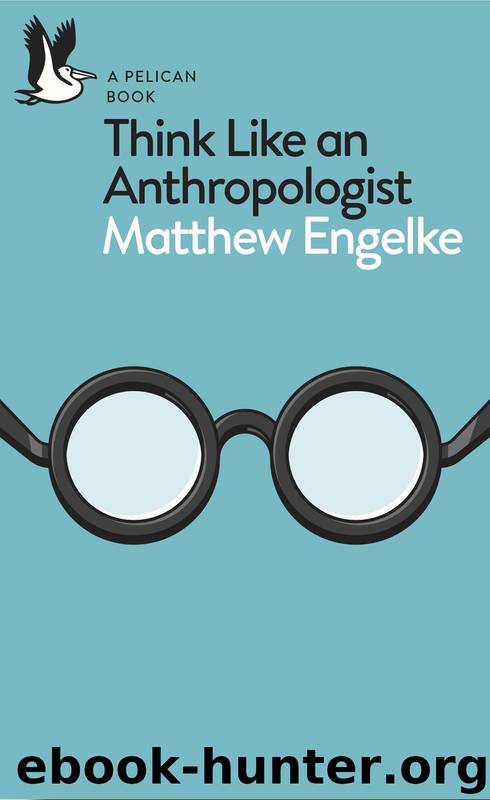
Think Like an Anthropologist by Matthew Engelke
Author:Matthew Engelke
Language: eng
Format: epub
ISBN: 9780141983233
Publisher: Penguin Books Ltd
Published: 2017-07-05T04:00:00+00:00
Race, again
And yet, despite the widespread recognition that identities can change and that identities are situational, there is a persistent tendency – even in a globalizing world full of rights-bearing individuals, expressing themselves freely – to think of identities as fixed, enduring and abiding. Remember, blood will out! Not in Janet Carsten’s subtle sense, but the unsubtle sense we find in the logic of racism and the one-drop rule.
I want to come back to race here, because it has posed one of the most significant challenges for anthropologists when it comes to such questions of identity. On the one hand, anthropological research can be used to show that, biologically speaking, race is a myth. On the other hand, it is a myth – like all myths – that carries a great deal of cultural significance. Race may be a myth, but ‘race’ is a powerful category nonetheless.
One of the hallmark studies in this area is Ashley Montagu’s 1942 book Man’s Most Dangerous Myth: The Fallacy of Race. A student of Franz Boas and Ruth Benedict (although introduced to anthropology in Bronislaw Malinowski’s London seminar), Montagu covered an incredible range of materials, from studies in biological sciences to the history of ideas – a history which shows quite clearly that the modern conception of race is rooted in European colonialism. In terms of the science, of course, the evidence base in 1942 was not as extensive as it is today. By the 1990s, physical anthropologists and geneticists had clearly shown that, in biological terms, there is only one human race; there are no human ‘subspecies’, to put it in more specialized language. Genetic diversity is very slight among human populations, especially when compared to other large mammalian species. Moreover, hypotheses about distinct evolutionary lineages (African, Eurasian) – much more common in Montagu’s day – have been questioned by advances in tracing evolutionary history through molecular genetics. As one of the leading researchers in this area puts it, ‘all of humanity [is] a single lineage, sharing a common long-term evolutionary fate’.9
In Chapter 1, I referred to an argument by Ruth Benedict that she made in support of this same point. Benedict, of course, did not have the data on genetics and evolutionary biology that is available today; she made her arguments more along the lines of culture and custom. It was an important set of arguments to make, however, and they were aimed against the likes of the State Registrar in Virginia, whose position against so-called miscegenation was grounded in the racist assertion that, eventually, the ‘negro type’ would emerge from anyone who carried just one drop of ‘colored blood’. To counter such arguments that race and cultural behaviour were linked, one of the examples that Benedict used was a hypothetical ‘interracial’ adoption. She writes: ‘An Oriental child adopted by an Occidental family learns English, shows towards its foster parents the attitudes current among the children he plays with, and grows up to the same professions that they elect. He learns the
Download
This site does not store any files on its server. We only index and link to content provided by other sites. Please contact the content providers to delete copyright contents if any and email us, we'll remove relevant links or contents immediately.
| Anthropology | Archaeology |
| Philosophy | Politics & Government |
| Social Sciences | Sociology |
| Women's Studies |
Born to Run: by Christopher McDougall(7132)
The Leavers by Lisa Ko(6950)
iGen by Jean M. Twenge(5419)
Sapiens by Yuval Noah Harari(5375)
Spare by Prince Harry The Duke of Sussex(5202)
The Kite Runner by Khaled Hosseini(5186)
Machine Learning at Scale with H2O by Gregory Keys | David Whiting(4317)
Bullshit Jobs by David Graeber(4197)
Never by Ken Follett(3963)
Goodbye Paradise(3813)
Livewired by David Eagleman(3778)
Fairy Tale by Stephen King(3403)
A Dictionary of Sociology by Unknown(3088)
Harry Potter 4 - Harry Potter and The Goblet of Fire by J.K.Rowling(3077)
The Social Psychology of Inequality by Unknown(3038)
Will by Will Smith(2930)
The Club by A.L. Brooks(2928)
0041152001443424520 .pdf by Unknown(2850)
People of the Earth: An Introduction to World Prehistory by Dr. Brian Fagan & Nadia Durrani(2740)
